
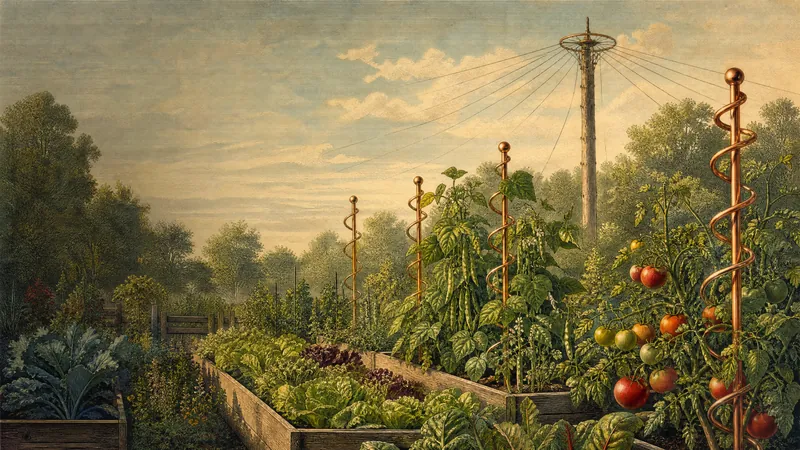
Illustration
Electroculture Gardening: History, Evidence and Honest Trials
Electroculture gardening uses copper antennas, wires or applied electricity to try to grow better plants; it has a 280-year history, but no controlled trial has yet confirmed that passive antennas raise yields.
By the Electroculture Gardening editors · Updated
Thrive Garden, which sells the electroculture antennas and copper stakes we link to, is a store owned by the same team as this site. Ownership disclosure
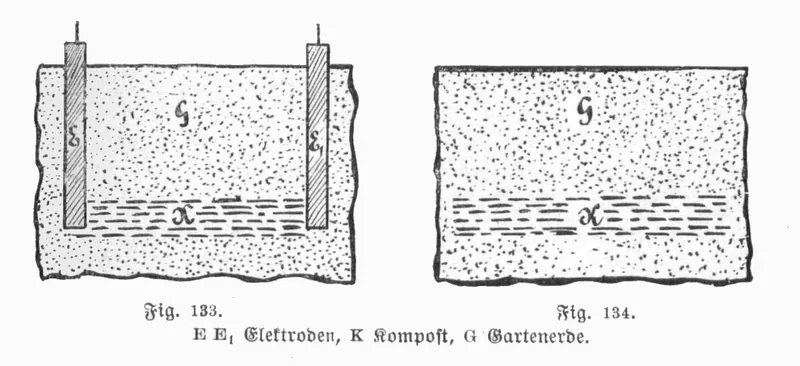
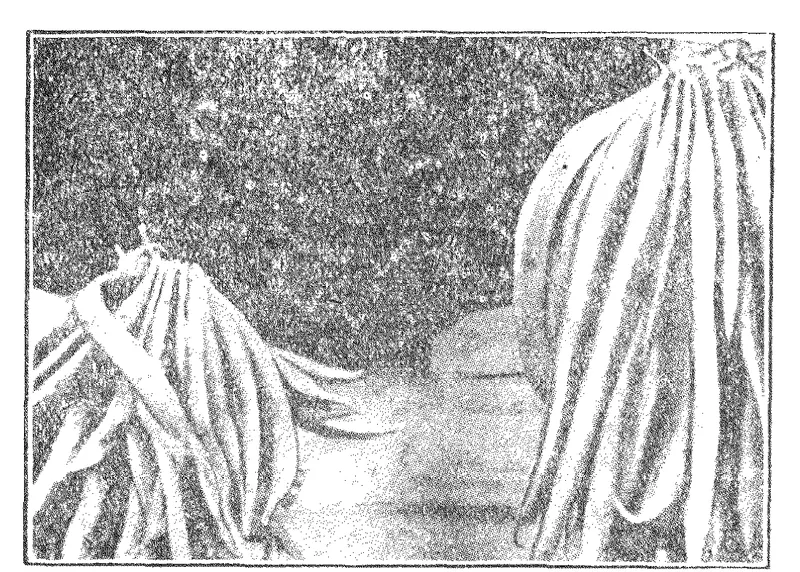

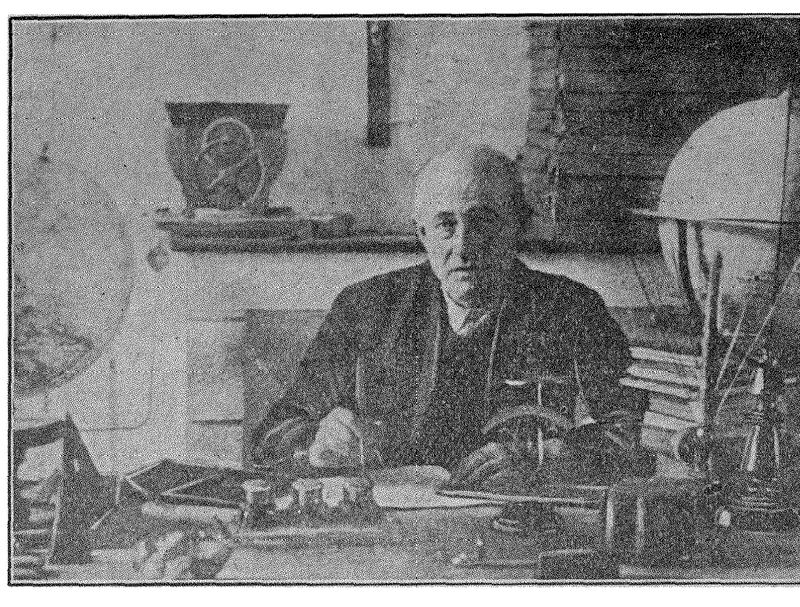
Electroculture gardening is an old idea with a modern following. Since the 1740s, experimenters have charged plants, strung wires over fields and buried copper and zinc in the soil, hoping that electricity would make crops grow faster. Today most gardeners meet it as a coiled copper stake pushed into a raised bed. This library reads the original documents, from an 1898 book to a 2025 controlled trial, and reports each result at the level of evidence it actually has.
Key takeaways
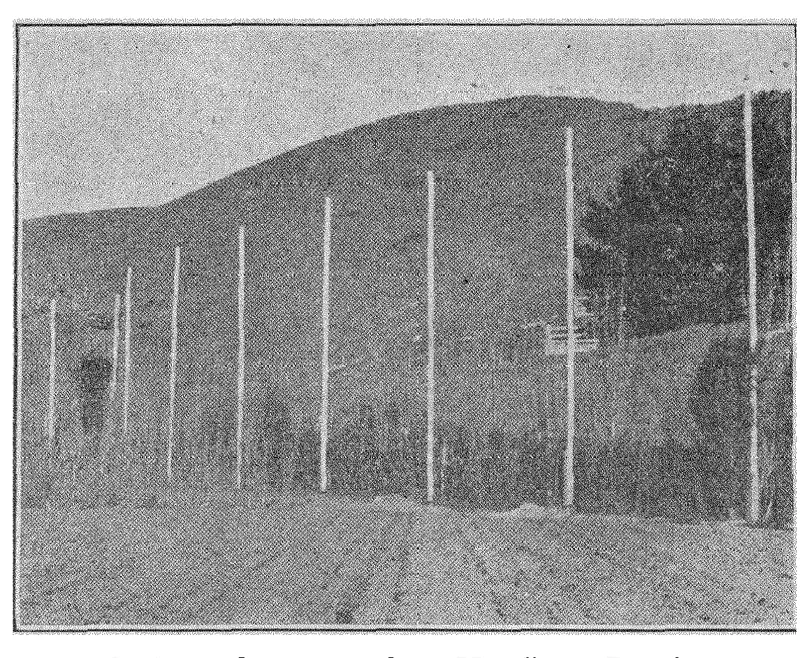
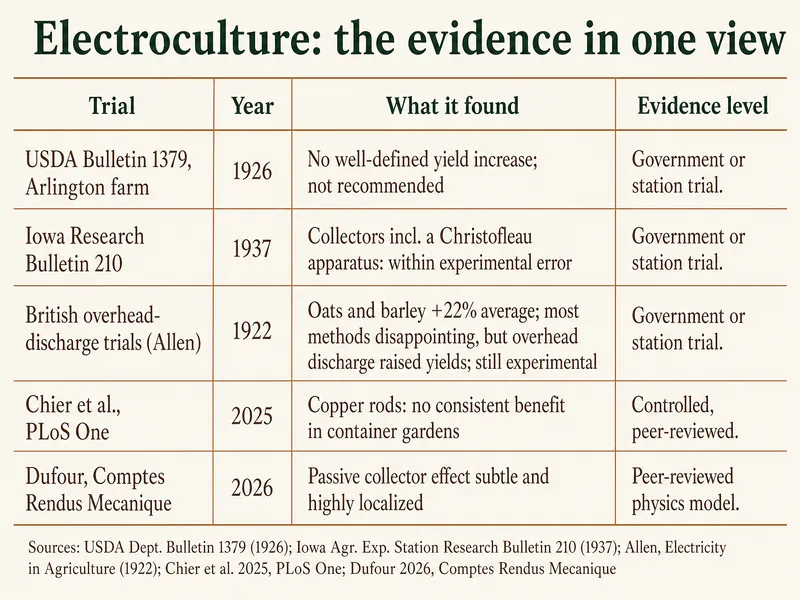
- The USDA's Bulletin 1379 (January 1926) tested charged wire networks over crops at Arlington Experiment Farm, Virginia, and concluded that electroculture "is not recommended".
- Iowa's 1937 Research Bulletin 210 tested five atmospheric collectors, including an original Christofleau apparatus; yield differences of -3.95% to +11.05% were all within experimental error.
- A 2025 controlled, peer-reviewed trial in PLoS One found copper rods carried about 2 millivolts into potting soil and gave no consistent benefit across four vegetable crops.
- British overhead-discharge trials reported by Arthur Allen in 1922 averaged +22% on spring oats and barley; Allen judged most electrical methods disappointing but concluded overhead high-voltage discharge raised yields, while calling it still experimental.
- A 2026 physics model by Thierry Dufour found a passive collector's effect in fair weather would be "subtle and highly localized", confined to millimetres or centimetres around its tips.
- The fair way to try it yourself is a side-by-side plot comparison: same soil, seed and water, antennas in one plot only, harvest weighed.
The evidence in numbers
- 1926Year the USDA's electroculture bulletin advised against the practiceUSDA Bulletin 1379
- 0.89-1.03Treated wheat grain as a fraction of the untreated plot, USDA's main 1914-18 series (11% below to 3% above)USDA Bulletin 1379, pp. 5-9
- 2 mVVoltage copper rods carried into soil in a 2025 trialChier et al. 2025, PLoS One
- +1%Mean result of Blackman and Legge's 47 pot trials, inside experimental errorBlackman and Legge, via USDA Bulletin 1379, p. 29
What is electroculture gardening?
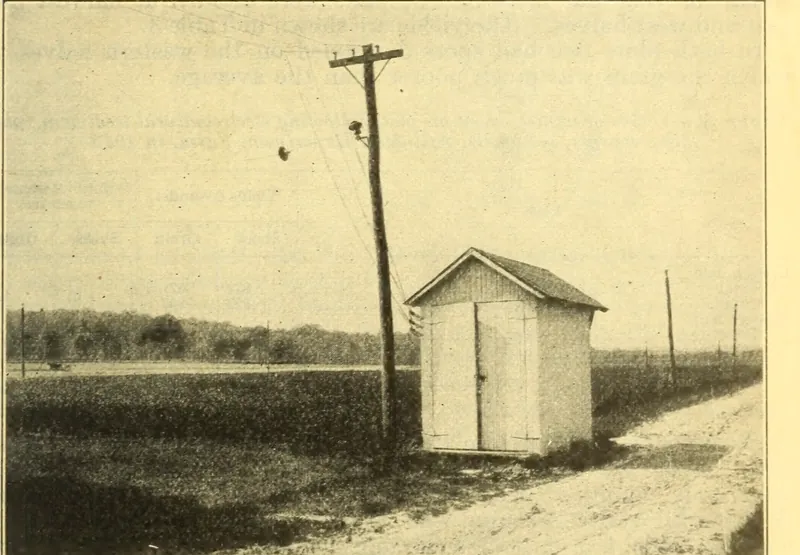
Electroculture gardening is the practice of using electricity, or devices said to gather it, to influence how plants grow. In home gardens that usually means passive copper antennas: coils, rods or wire-wrapped stakes with no battery, placed among the plants. Historically it also meant powered systems, such as the high-voltage wire networks that Finnish physicist Selim Lemström and later the USDA strung over test fields.
The idea rests on a real fact. The air above the ground carries an electric field of about 100 volts per metre in fair weather, a figure the USDA bulletin itself gives on its second page. The open question is whether a copper stake can turn that field into anything a plant can use. Our plain-English definition explains the passive and active types in more detail.
Does electroculture gardening work?
No controlled study has shown that passive electroculture antennas raise garden yields. The most direct modern test, a 2025 study by Chier and colleagues (Lemoine lab, Marquette University), compared four pot-grown vegetables given exposed copper rods, buried copper rods or no copper. Their controlled, peer-reviewed result: no effect on plant height or leaf greenness, a small biomass gain for beets and turnips with buried copper, and no gain with exposed antennas.
The older government record points the same way. The USDA's 1926 bulletin found its own Arlington trials gave no well-defined increase, and Iowa's station trials of 1930-1934 ended with the verdict that the matter "must remain debatable". Our full review of whether electroculture works weighs every result, and the electroculture studies table lists them side by side.
| Trial | Year | Method | Result | Evidence level |
|---|---|---|---|---|
| USDA Bulletin 1379, Arlington, Va. | 1907-1918, published 1926 | Charged overhead networks, 30-60 kV | Main winter-wheat series, 1914-18: grain 89-103% of the untreated plot; advised against | Controlled government or station trial |
| Iowa Research Bulletin 210 | 1930-1934, published 1937 | Atmospheric collectors, earth cells, high voltage to roots | Collectors within error; one significant oat gain on poor soil that did not repeat | Controlled government or station trial |
| Blackman's British field trials, via USDA | 1915-1920 | Overhead discharge | 33 trials averaged +14%; largest gains beside weak control strips | Controlled government or station trial |
| Allen, Electricity in Agriculture | 1922 | Overhead discharge | Committee average +22% for spring oats and barley; Allen still called the method experimental | Controlled government or station trial |
| Lemström, via Hull 1898 | 1885 | Charged wires over barley | Crop up by one third | Historical report |
| Chier et al., PLoS One | 2025 | Passive copper rods in pots | No consistent benefit | Controlled, peer-reviewed |
Where did electroculture come from?
Electroculture began in the 18th century, soon after the Leyden jar made stored electricity easy to produce. George S. Hull's 1898 book Electro-Horticulture records that Dr. Maimbray of Edinburgh electrified two myrtle trees in 1746, and that Abbé Bertholon took up the subject in 1783 with a pointed collector rod. Jan Ingenhousz found no benefit in 1787, which Hull says "chilled the enthusiasm" for a time.
Interest returned in the 1880s. Hull reports that Lemström's barley at Niemis, Finland, yielded about a third more under charged wires in 1885, a historical report without modern controls. In the 1920s the French inventor Justin Christofleau sold a mast-mounted collector with a buried iron wire, and his booklet claimed gains of "100 to 200 per cent", a promotional claim that Iowa's later test of his apparatus did not support. The electroculture history page and our profile of Justin Christofleau follow both stories from the primary documents.
What does science say about electricity and plants?
Electricity clearly affects plants when it is delivered at a controlled dose, but that is different from what a passive antenna does. Powered seed treatments with strong electric fields or cold plasma change germination in laboratory studies, and Dufour's 2026 review in Comptes Rendus Mécanique says the historical current of electroculture "did not directly evolve into or compete with plasma-based technologies". The effects come from ozone, reactive chemistry and ultraviolet light produced by kilovolt sources, which a copper coil does not make.
For passive devices, the numbers are small. Dufour's model of Bertholon's 1783 collector shows the field concentrating 175 to 700 times near the tips in fair weather, but only within centimetres, with fair-weather currents of trillionths of an amp per square metre, rising to billionths only in storms. WSU Extension adds a likely reason plants green up after thunderstorms: lightning fixes atmospheric nitrogen into nitrate, which the rain carries into the soil. Read more on atmospheric electricity and plants and on plasma agriculture.
Which electroculture antennas can you try?
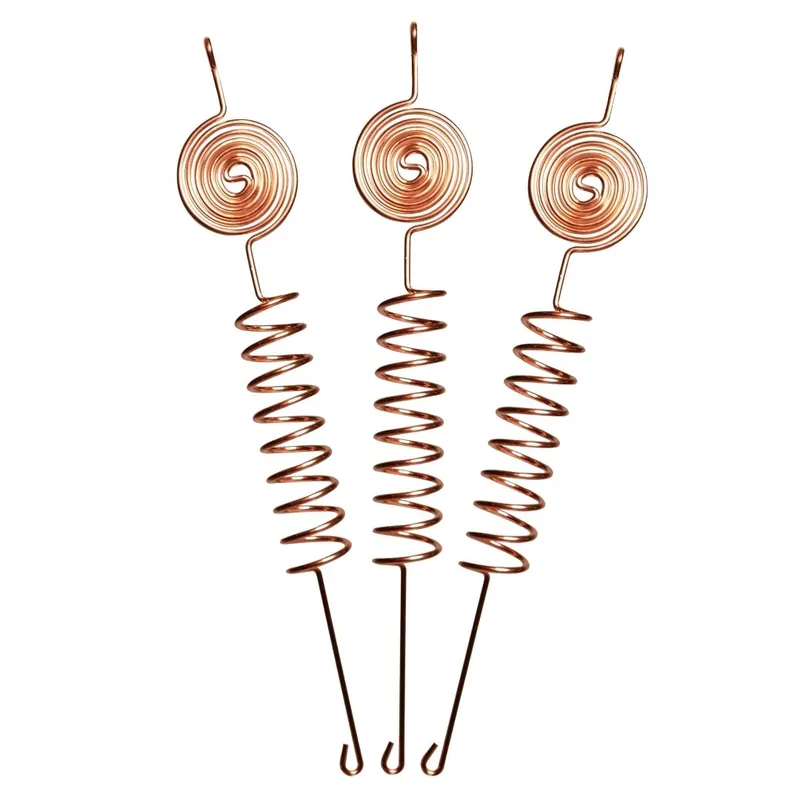
Most home electroculture antennas are solid copper stakes with a coil or spiral; homemade ones cost little, and Thrive Garden's ready-made stakes work out at about $11.33 to $13 each depending on pack size. The common designs are the coiled "Tesla coil" stake, wire wound around a wooden dowel, and decorative shapes such as copper butterflies; our guide to electroculture antennas compares them, and the antenna designs page shows the historical diagrams behind them.
Thrive Garden, a store owned by the same team as this site, sells the Tesla Coil Electroculture Antenna: stakes listed as 99.9% copper, about 11.5 inches (29 cm) long, with a clockwise coil. The store's prices on October 23, 2026 were $39 for 3, $73 for 6, $141 for 12 and $272 for 24. Thrive Garden says it has observed healthier plants near the antennas; that is the store's own observation, an anecdote rather than a controlled result. The authors of the 2025 controlled trial went further, concluding that making or buying such devices "would waste both financial and natural resources" (Chier et al. 2025). Treat the stakes as a low-cost experiment and as durable copper garden markers, and browse the full electroculture collection (Thrive Garden, a store we own) if you want other shapes.
Try it in your own beds
Tesla Coil Electroculture Antenna Starter Pack
Check current pack sizes and prices at Thrive Garden, then set up a fair side-by-side test.
View at Thrive GardenThrive Garden, which sells the electroculture antennas and copper stakes we link to, is a store owned by the same team as this site. Ownership disclosure
How do you test electroculture in your own garden?
You test electroculture by growing two matched plots, one with antennas and one without, and weighing what each produces. Use the same soil, seed variety, sowing date, watering and sun for both, and decide which plot gets the copper by tossing a coin. Several pairs of small plots tell you far more than one big pair, because the USDA found that untreated plots on the same farm could differ by 40% or more in a single season.
Write everything down: planting dates, rainfall, pests and final harvest weight per plot. Repeat for a second season before drawing a conclusion. The step-by-step method is on how to test electroculture, and electroculture gardening for beginners covers the soil, water and sun basics that matter more than any antenna.
How we put this page together
The front page condenses the library's core documents. For history: Hull (1898), Allen (1922) and the Christofleau booklet (about 1927). For field trials: the USDA's Bulletin 1379 of 1926 and Iowa's Research Bulletin 210 of 1937. For modern work: the PLoS One copper-rod paper (2025), Dufour's physics papers (2026) and a WSU Extension article (2024). Sources and store prices were checked on October 23, 2026. Left out: forum and social-media anecdotes, health claims made for electroculture devices, and yield figures that could not be traced to an original document.
Common questions
Is electroculture gardening safe to try at home?
Passive copper antennas carry no power source and are as safe as any metal garden stake, apart from sharp tips around children and pets. Powered high-voltage setups like the 30,000-60,000 volt networks in the USDA trials are dangerous and have no place in a home garden. Keep any experiment passive.
How much does it cost to start electroculture gardening?
A small trial can cost almost nothing if you wind copper wire around a wooden stake. Thrive Garden's Tesla Coil starter pack listed at $39 for three antennas on October 23, 2026. A fair test also needs a scale to weigh the harvest from each plot.
Do copper antennas replace fertilizer or watering?
No controlled study supports that. The USDA found charged cowpeas used slightly more water than controls, 449 against 429 units of water per unit of dry matter. Feed and water according to a soil test and your crop's needs whatever else you try.
What did the 2025 PLoS One electroculture study test?
It tested passive copper-coiled dowels on mustard greens, kale, turnips and beets, with 10 plants per treatment per species, over eight weeks under LED grow lights. Exposed rods changed nothing that was measured. Buried rods gave beets and turnips about 2.5 g more leaf and stem weight (p < 0.01), which the authors called "likely ... simply a result of small sample sizes".
Why do so many gardeners say electroculture works for them?
Season-to-season weather, better soil in one bed, new compost and closer attention can all make a garden look better in the year antennas go in. Without a matched control plot, those effects are hard to separate from the antenna. Many gardeners report good results; controlled trials have not confirmed them.
Who invented electroculture?
No single person did. Hull's 1898 book traces the first experiments to the 1740s, with Bertholon's 1783 collector as the first well-described device, and Selim Lemström and Justin Christofleau popularising it later. The word itself titles both the USDA's 1926 bulletin and Christofleau's booklet.
Is this site connected to Thrive Garden?
Yes. Thrive Garden, which sells the electroculture antennas and copper stakes linked here, is owned by the same team as this site. The details are on our ownership disclosure page.